Cool Kids · Studio thesis & first title · for Stake Engine
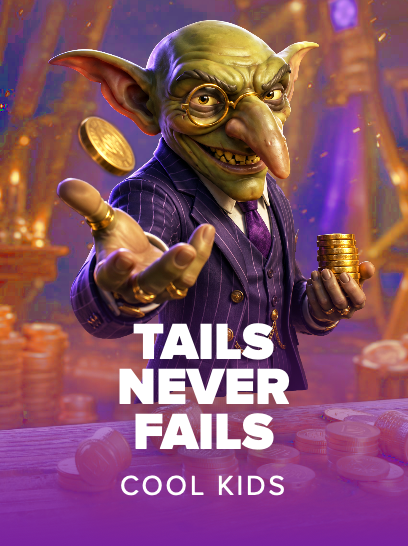
TAILS NEVER FAILS
We chose the simplest game on the platform — a coin flip — on purpose, and built it like a premium title. This is our thesis, executed once: proof that "simple" and "signature" are not opposites.
✓ Approved & publishing on StakeCoin-flip · 2 coversRTP 96.00% exact · 9 bet modesMax win ×15000Custom HTML5 · full RGS client
0.9600 RTP, exact ×9 modes
57,819 books, 0 mismatches
×15000 declared wincap
01 — The studio thesis
We upgrade the simplest games. Deliberately.
Every studio arriving on a slots platform makes the same move: another five-reel machine, a fresh skin, the same maths, the same feel. The catalogue becomes a hall of mirrors. Cool Kids made the opposite bet.
The "simple games" — coin flip, dice, mines, plinko — are treated across the industry as filler: cheap to produce, quick to ship, disposable. We think that's a category error. A simple game isn't a lesser game — it's the purest expression of the gamble, and it is by far the hardest to make unforgettable, because there is nothing to hide behind. When the mechanic is one tap, every gram of craft has to go into feel, character and production value. That's a much higher bar than bolting on a fourth bonus round.
So we don't arrive with another slot. We arrive with a decision: take the single most elementary gambling atom on Stake — a coin flip — and upgrade it into a premium, emotional, self-marketing product. Not to out-complicate the field. To out-craft it on the fundamentals everyone else skips.
The strategic edge — simplicity is the only thing that scales. A game understood in one second, in any language, with no tutorial — wrapped in a character that makes people feel something — is natively viral. Complexity fragments the audience; simplicity reaches every player and fits every clip. We don't out-feature the market. We out-craft it on the basics — and that is a signature no reskin can copy.
What the player actually does — and the seam we close
We didn't land on a coin flip by taste. We reverse-engineered it from how players and streamers actually spend a session — and the same person moves between two machines all night:
On a simple game — a coin flip, a dice — they play for the double: a two-tap hit of adrenaline, in and out, nothing standing between them and the result.
On a slot they do two other things entirely — they spin on autopilot while they talk to their chat (the social, ambient half of a stream), and they buy the bonus when the room needs a spike of pressure.
Three instincts, stranded across two different machines — and the player pays the switching cost every time the mood turns, jumping from one category to the other. The industry treats that seam as a law of the medium. We treat it as the opening.
Tails Never Fails closes the seam. The instant TAILS double, the react-and-talk loop that carries a stream, and the ×100 buy that spikes the tension — the three things a player used to spread across two machines, now living in one game, a single tap apart. We aren't adding another title to the pile; we're folding two of the player's oldest habits into one product — the kind of move that turns a category into a home.
This dossier is that thesis executed once — Tails Never Fails. Everything below (the emotional layer, the exact maths, the source-verified engineering) is the evidence that a studio can treat "simple" as a canvas for premium work, not an excuse to ship less.
02 — The hook
Why people play — and where we put the emotion
People gamble for two primal reasons: the hope of winning, and a bracket of experience outside the social frame — a thrill at the edge of the "work = money" contract.
Most machines drown that essence under paylines, scatters and nested bonuses. Tails Never Fails does the opposite: it distils gambling down to its most fundamental atom — a coin flip — that anyone grasps in one second. The name comes from the superstitious phrase people mutter before flipping: "tails never fails." It already carries the promise and the folklore of the gesture.
Our upgrade — the antagonist made flesh. The game isn't neutral: it has a face. A villain who reacts emotionally to your result — he gloats when you lose, rages when you win, and breaks down in tears when you crack the EDGE. The player stops only chasing money and starts playing to make the villain cry. That schadenfreude hook is what turns a coin flip into a clip machine — and gives a streamer a goal beyond the payout. This is the exact difference between a simple game and an upgraded one.
Positioning note: the villain is a fictional archetype of greed, never a real target — an ethical choice and a business one, keeping the game clean of any content built on a real group's identity.
03 — The game
One coin, three outcomes, two covers
A single three-faced coin per villain. The player covers one or both winning faces, sets a bet, and flips (FLIP button or spacebar). HEADS always loses.
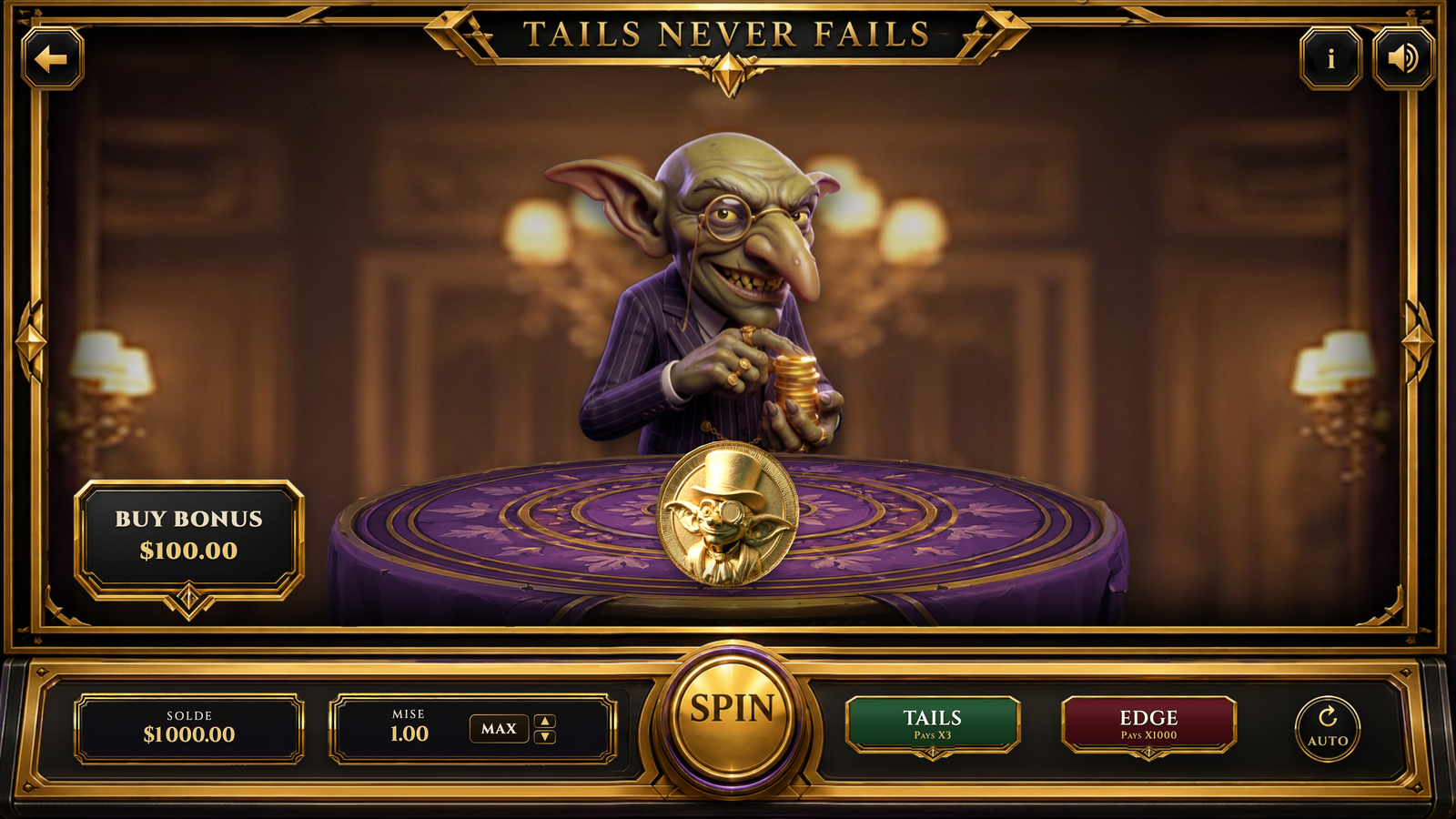
The live machine — The Goblin Banker at his table. Ornate frame, animated villain, real 3D coin, and the full bet bar (SPIN · TAILS · EDGE · BUY BONUS · autoplay).
TAILSpays ×3
HEADSalways loses ☠
EDGEpays the jackpot
TAILS (×3) — the grind cover. Frequent, pays often, keeps the player alive and the dopamine flowing.
EDGE (jackpot) — the rim: the coin lands balanced on its edge. The near-impossible event, the moonshot — the "what if it lands on its edge?" everyone has fantasised about, made playable. Reached by covering TAILS + EDGE together (cost ×2).
HEADS — always loses. The house's weight, the moment the villain gloats.
The design strength: EDGE gives an intuitive name and image to the jackpot. Nobody needs it explained why it's rare and why it pays huge — it's playground physics.
Stream loop. Flip → villain reaction → result. The clip writes itself: rage on a big TAILS, an emotional apocalypse on an EDGE. Vertical-native, zero editing, infinitely repeatable — reach by construction.
04 — The roster
Choose your opponent (= your volatility)
Like a fighting-game select screen, the player picks the villain they want to face. Each villain = a volatility profile. The RTP stays fair and identical (96.00% exact, certifiable); what changes is the EDGE top multiplier and its rarity — the real lever of sensation.
Lead · High volatility
The Goblin Banker
A grasping goblin with hooked fingers, clutching his hoard. Grotesque, comic, 100% fictional greed. He keeps the biggest pile — so the biggest jackpot.
EDGE ×1000 · ~1 / 1,042 The ultimate moonshot.
Medium volatility
Panther Oligarch
A luxury-suited billionaire panther, cigar and gold chain. "The house that hates to pay," incarnate. Timeless, streamable, safe.
EDGE ×100 · ~1 / 104 The risk/frequency balance.
Low volatility
Punk Ferret
A blue-haired punk ferret, all attitude. Cocky, modern, ultra-streamable — and the softest ride of the three.
The roster IS the roadmap. Each new villain is a content event — a season, a streamer collab, an event skin — that ships as a drop-in EDGE multiplier + art pack, with zero engine changes. The same signature (a simple game, upgraded) extends indefinitely without ever rebuilding the machine.
05 — The math
Model, RTP & volatility — exact to the tenth decimal
The coin is a single three-faced object. Coverage = the bet mode. 9 bet modes total = 3 villains × 3 coverages:
Mode
Cost
Covers
Reach
RTP
Max win
<villain>_tails
×1
TAILS
×3 + bonus
96.00%
×15000
<villain>_both
×2
TAILS + EDGE
×3 / jackpot + bonus
96.00%
×15000
<villain>_bonusbuy
×100
is_buybonus
buys the bonus
96.00%
×15000
Why RTP is exact, not "targeted". We don't rely on optimiser convergence. Every mode's RTP is computed and pinned in exact rational arithmetic (Python Fraction) so that sum(weight·payout) / (sum(weight)·cost) equals 24/25 = 0.9600000000 — verified to the tenth decimal across all 9 modes. Weights are uint64; the lookup tables and books were validated line-by-line (57,819 books, 0 book↔LUT mismatches, all config hashes valid), and the file format was checked against the math-sdk writers themselves (JSONL + zstd, LF line endings, index.json schema).
The base flip
Base probability of TAILS is P(tails) = 0.2801684. It's not 96/3 = 0.32 — it's slightly lowered to fund the bonus so the total RTP still lands on exactly 0.96. It solves, in closed form:
3·p  +  96 · q(p)  =  0.96        with  q(p) = p⁵(1-p)/(1-p⁵)
→  p = 0.2801684   (residual −2.1e-7, tighter than 6-dp rounding)
where q(p) is the stationary frequency of a 5-in-a-row streak — preserved by the in-book conversion (see §06). EDGE probability is P(edge) = RTP / edge, reachable only in the both mode.
EDGE — the volatility lever
Villain
EDGE ×
P(edge)
Frequency
RTP
Volatility
Goblin Banker
×1000
0.00096
~1 / 1,042
96.00%
High
Panther Oligarch
×100
0.00960
~1 / 104
96.00%
Medium
Punk Ferret
×50
0.01920
~1 / 52
96.00%
Low
The right lever. RTP is held identical across villains (fairness + simple certification). What changes the feel is the size of the top-multi and its rarity. Bigger jackpot ⇒ rarer EDGE ⇒ higher variance ⇒ shorter time-to-ruin — but honest expectation throughout.
A design note we corrected in review. Standalone EDGE-only modes were removed: at ~1 in 1,042 they read as ~99.9% non-paying, which trips the math-review "non-paying results" heuristic. EDGE is now reachable only via the both cover, whose ~28-30% hit rate is squarely in range. The player still gets full jackpot access — just always paired with TAILS.
06 — The bonus
Five free flips, a random announced stake, and a fully stateless trigger
The feature is the soul of the machine. Any TAILS win can trigger it (~1 in 803 rounds, i.e. 1 in ~225 TAILS wins), or the player can buy it for ×100.
5 free flips, 2 coins each (a role reversal — now the player "cheats" and tosses two coins).
Random announced stake per flip. Before every free flip a multiplier M ∈ {1,2,5,10,25,50,100,250,1000,2500} is drawn and announced on screen — "SPIN €1,000!!". Each TAILS coin then pays 3·M the base bet.
This hides the max win in the moment (the player never knows the next flip's stake) while the ×15000 cap is fully disclosed in the rules — Stake-style variable bonus, honest ceiling.
Fair buy price, exact. The capped bonus EV is calibrated to 96× the base bet (exact 5-flip convolution over Fractions, residual 3.4e-6). Buy cost = EV / RTP = 96 / 0.96 = ×100 → buy-mode RTP = 96/100 = 0.9600 exact, scaling with the bet.
Fully stateless by design — no gauge, no streak. Stake's RGS is strictly stateless: an outcome can't depend on prior rounds. So the bonus lives entirely in the books — every tails-win book independently carries it with the exact conditional probability r ≈ 1/225, so it simply triggers at random on any TAILS win (~1 round in 803), with no cross-round state of any kind. Every payout — including the ×15000 wincap outcome — is pre-generated; the front end only animates the bonusFlip events. (That rate r = q/p is derived from a 5-in-a-row streak frequency — which is why P(tails) is tuned to 0.2801684 — but nothing is ever tracked between bets.) 100% RGS-compliant.
Odds, verified
Metric
Value
Method
Bonus trigger (natural)
~1 / 803 rounds
exact — matches rules claim to ±0.05%
Bonus EV (capped)
96× the bet
exact convolution + 2M Monte-Carlo cross-check
P(bonus pays 0)
3.74%
exact
P(hitting the ×15000 cap) per bonus-buy
~1 / 12,730
exact
Base hit rate (tails / both)
28.0% / 28-30%
from lookup tables
The "feint" — a deliberate, disclosed presentation. On ~5% of HEADS losses where EDGE is covered, the game plays the EDGE-win cinematic which then topples over at the very end. It is presentation only — the losing outcome is fixed in the book before the animation runs — and it is described in the game rules. We're flagging it explicitly so a reviewer never reads it as a misleading win; it's the coin-flip equivalent of a near-miss animation, fully server-truthful.
07 — Engineering & conformity
A custom HTML5 client, verified against your own source
Per the docs ("Developers utilizing their own frontend and/or math solutions are welcome"), we shipped a custom, self-contained HTML5 front end — not the web-sdk — that is a full RGS client. It is published and running on the live RGS (real balance, real session). Upgrading a simple game means owning the whole stack, not stitching a template.
Area
What we did
Status
RGS client
authenticate → play → end-round (+ balance, bet/event), micro-unit amounts (×1e6), rgs_url/sessionID/lang/device/social from the launch URL, active-round resume, full error-code handling.
✓ live
Verified vs. source
We read the ts-client & web-sdk source and fixed to match: payoutMultiplier is a direct float (not ×100), /bet/event takes a string, errors can arrive in a 200 body, replay amount is micro-units.
✓ matched
Bet Replay
replay=true path: GET /bet/replay/…, the full bet bar stays on screen and the SPIN button re-plays the round, zero authenticated wallet calls.
✓
Social (stake.us)
Full restricted-phrase replacement (bet→play, pays→wins, buy→bonus, cash→coins…) across UI, rules and baked image text; SC/GC display without $.
✓ audited, 0 residuals
CSP compliance
The CDN blocks blob:. Three.js decoded the coin's textures via blob URLs → white coin in prod. Fixed by shipping the coin as a data-URI glTF; verified against your exact connect-src policy.
✓ golden coin in prod
Presentation layer
18 chroma-keyed villain reaction clips keyed live on canvas (Safari included), a real 3D coin (Three.js), full-screen cinematics for EDGE / feint / bonus, and a purpose-built portrait (mobile) layout rebuilt layer-by-layer to fill any phone.
✓
IP hygiene
Cinzel & Lilita One (SIL OFL), background music (Pixabay, certificate on file), three.js (MIT). Zero GPL/copyleft anywhere in the bundle.
✓
Review artefacts ready. A REVIEW-EVENTS.md ships book IDs per mode for every outcome class — loss / normal win / big win / wincap ×15000 / bonus trigger — e.g. goblin_both: loss = 1, TAILS ×3 = 2, EDGE ×1000 = 3, wincap = 5460.
08 — Status & roadmap
Approved, publishing — and a studio that levels up
✓ Reviewed by three independent reviewers and approved for publication on Stake. The maths passed clean; the first pass on presentation came back below bar, so we treated the reviewers' notes as a spec and rebuilt the entire feel layer — mobile portrait, animation transitions, controls, replay — then cleared the threshold on resubmission. A studio that ships, listens, and levels up is the whole point of the thesis.
Radical simplicity, native virality
No tutorial, understood in one second, in any language. The villain reaction makes every round a vertical clip with zero editing — content that films itself, which is exactly what drives organic reach and streamer engagement.
Certification-friendly by construction
One RTP (0.96) across all modes, a declared ×15000 wincap that's achievable, healthy hit rates, no cross-round state, stateless bonus. The math was engineered to pass review, not to squeak through it.
Extensible content engine
Each new villain is a drop-in EDGE multiplier + art pack — a season, a collab, an event skin — with no engine work. And the thesis generalises: the next title takes the next simple mechanic (dice, mines, plinko) and gives it the same premium, character-led treatment.
The identity
Cool Kids is the studio that elevates simple games instead of cloning complex ones. Every title we ship will take a mechanic the industry treats as filler and give it the production value, character and emotional hook usually reserved for AAA. That is a lane almost no one is running — and it's ours.
In one line. We arrived on Stake with a point of view, not a template: a simple game, upgraded, is a signature — and Tails Never Fails is the proof, built with the platform's rigor end-to-end and now cleared for players.